Key Takeaways
- Match the provider to the task. The scope of the work, not the provider's label, decides whether licensing, permit, and refrigerant rules apply.
- Hire a licensed contractor in California for permit-required work, work that uses employee labor, or jobs totaling $1,000 or more in labor and materials.
- Confirm EPA Section 608 certification before anyone opens the sealed refrigerant circuit. A contractor license does not prove it.
- Stop and call a professional for repeated breaker trips, ice, burning odors, significant leaks, or suspected refrigerant problems.
- Compare written estimates on the diagnosed fault, parts, labor, permits, and warranty, not just the lowest price.
HVAC company vs handyman is a safety and accountability decision, not just a price comparison. An air conditioner that blows warm air, cycles repeatedly, leaks water, freezes, or trips a breaker can have electrical, airflow, refrigerant, control, or drainage causes. Each cause calls for different tools and credentials. Since 2017, Alpine Plumbing, Heating, and Air has provided licensed AC repair for homes and commercial properties across Southern California.
What follows is a side-by-side look at licensing, EPA refrigerant certification, trade scope, safe owner checks, diagnostic methods, consumer protections, and the different needs of residential and commercial buyers. Use it to match your AC repair to the credentials and accountability the job requires.
HVAC Company vs Handyman: What Defines Each Provider
A licensed HVAC company specializes in heating and cooling diagnosis, service, repair, maintenance, and installation. A handyman has broad property-maintenance skills that vary by individual. The difference matters because an air conditioning system involves line voltage, capacitors, motors, controls, sealed refrigerant circuits, airflow measurement, and condensate management, plus equipment specifications, permits, and manufacturer procedures.
| Factor |
Licensed HVAC company |
Handyman |
| Typical scope |
Heating and cooling diagnosis, repair, maintenance, installation |
Broad property maintenance; skills vary by individual |
| Diagnosis |
Measures electrical, temperature, pressure, airflow, and control conditions |
May focus on visible symptoms or basic part swaps |
| Licensing |
Verifiable CSLB record with a classification and status |
May be unlicensed or licensed in a classification that excludes HVAC |
| Refrigerant |
HVAC technicians should hold the right EPA Section 608 type |
Title does not imply Section 608 certification |
| Capacity |
May offer dispatch, stocked vehicles, and multiple technicians |
Often one-person availability and a narrower parts inventory |
| Warranty |
May offer documented labor warranties and manufacturer channels |
Varies by individual |
Training and Safety Set the Gap
HVAC postsecondary programs generally last 6 months to 2 years, followed by on-the-job training. Bureau of Labor Statistics data shows HVAC technicians work around electrical parts, chemicals, heavy equipment, and refrigerants, and the occupation has one of the higher injury and illness rates. That risk keeps electrical and refrigerant repair out of casual DIY territory. A handyman may not keep current refrigerant, electrical code, or manufacturer training. Some of the common causes of AC failure, such as electrical faults, refrigerant leaks, and compressor problems, cannot be diagnosed without specialized tools.
HVAC Company vs Handyman: Licensing and Certification Differences
California's Contractors State License Board (CSLB) requires a contractor license when a project needs a building permit, uses employee labor, or totals $1,000 or more in combined labor and materials. Permit-required work and employee labor each trigger licensing on their own, separate from the $1,000 threshold. CSLB licenses contractors across 45 classifications, and C-20 covers warm-air heating, ventilating, and air-conditioning work.
Two different credentials can apply to the same AC repair:
| Credential |
What it covers |
What it does not prove |
| CSLB contractor license |
The business and its authorized scope |
An individual technician's refrigerant certification |
| EPA Section 608 certification |
A technician's authority to handle regulated refrigerant |
Workmanship, insurance, or company quality |
EPA Section 608 certification is required for any activity that could release refrigerant, including attaching or detaching gauges and adding or removing refrigerant. It has four types: Type I for small appliances, Type II for high- or very-high-pressure appliances, Type III for low-pressure appliances, and Universal for all equipment. The credentials do not expire. Apprentices may work without certification only under close and continual supervision by a certified technician. Knowing how to choose an HVAC company starts with checking both the state license and the assigned technician's refrigerant credentials.
CSLB warns that unlicensed operators can expose consumers to worker injury, property damage, faulty or incomplete work, and missing bonds or workers' compensation coverage.
Refrigerant Rules Reach Heat Pumps and Newer Equipment
Air conditioners, air source heat pumps, ground-source heat pumps, and ductless systems all move heat through a sealed refrigeration cycle, and that heat exchange depends on a correctly charged circuit. Equipment that uses lower-GWP refrigerants brings its own handling and safety requirements. Adding refrigerant is not a generic tune-up. Too much or too little reduces efficiency, raises energy costs, and shortens equipment life, so a qualified diagnosis should find out why the charge is wrong.
AC Repair Professional vs DIY: Safe Owner Checks and Hard Limits
Owners can safely observe the system without opening panels or touching electrical or refrigerant parts. These checks help technicians and sometimes reveal a simple fix:
- Confirm the mode and setpoint on your thermostat or Smart Thermostat.
- Check whether the air filter looks visibly dirty.
- Confirm the supply vents are open.
- Check once for an obviously tripped circuit breaker.
- Note ice, water, odors, noises, cycling, and error codes, and record when each starts.
Stop the system and call a professional for any of these:
- Burning odors, smoke, sparking, or exposed or damaged wiring
- A repeated breaker trip
- Ice buildup on indoor or outdoor coils
- Significant water leakage
- Warm air in cooling mode or a suspected refrigerant leak
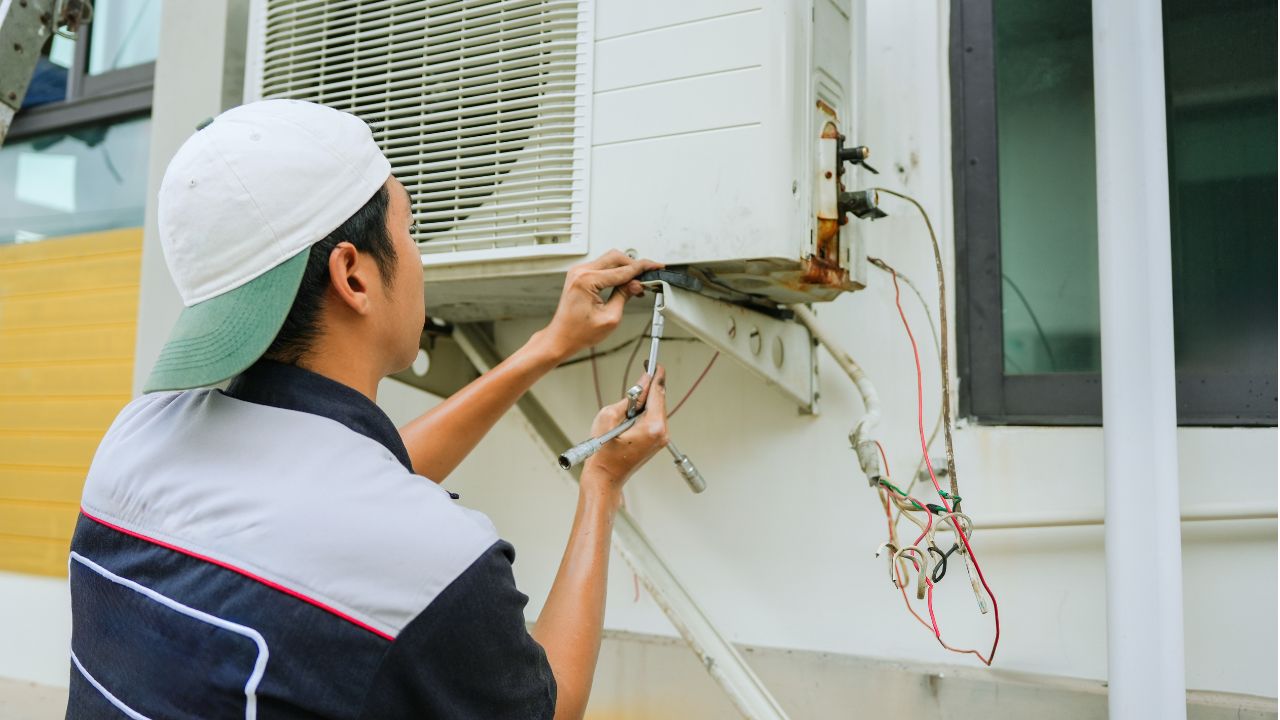
Do not reset a breaker repeatedly, open the electrical panel or the AC disconnect box, handle capacitors, or try to replace parts. Voltage hazards in the outdoor unit, the fuse box, and the disconnect can cause shock or fire. An outdoor unit that will not start can involve power, thermostat calls, safeties, controls, motor components, or compressor conditions. Do not open refrigerant fittings, attach gauges, or add refrigerant either, because those steps release regulated substances. When a stop-and-call symptom appears, book emergency AC repair instead of experimenting.
Residential AC Troubleshooting Requires Measurement, Not Guesswork
Weak airflow or poor cooling can come from a dirty filter, blower problem, duct restriction, dirty coil, control issue, low refrigerant, compressor problem, or incorrect operation. Replacing one visible part without measuring system conditions can miss the root cause and trigger repeat service calls. Professional Troubleshooting AC work starts with power and ends with a retest.
| Fault area |
What goes wrong |
What a technician measures |
| Electrical problems |
Faulty capacitor, contactor, motor, or control board; misdiagnosis can damage motors and compressors |
Incoming voltage, motor amperage, capacitance, coil voltage |
| Refrigerant |
Refrigerant leaks cut cooling capacity, raise energy use, and can cause compressor failure |
Pressures, superheat, subcooling, temperature differential |
| Airflow |
A dirty air filter, blocked condenser coils, or a blower problem cuts efficiency and can freeze the evaporator coil |
Static pressure, airflow, ventilation flow at the vents |
| Drainage |
Blocked drain line, pan damage, bad slope, or float-switch trouble; freezing from airflow or refrigerant faults |
Drain path, float switch, cause of any freeze |
Central AC equipment includes line voltage, contactors, capacitors, motors, control boards, disconnects, and low-voltage circuits. The outdoor condenser unit, the air handler, and the refrigerant lines between them each add failure points. Frozen coils and ice buildup often start with an airflow or refrigerant fault, so clearing the drain line alone does not solve them. A plugged condensate drain can also cause water damage.
Symptom-Only Fixes Create Repeat Failures
Replacing a capacitor without measuring voltage, amperage, and motor condition can leave an electrical fault in place. Installing a contactor without checking coil voltage or testing the AC compressor can end in immediate re-failure. Overcharging refrigerant damages the compressor, undercharging cuts capacity, and incorrect capacitor ratings overheat motors or keep them from starting. These guesses waste money while the real problem continues.
Systematic Diagnosis Uses Real Instruments
HVAC technicians use multimeters, clamp meters, capacitance testers, manifold gauges, thermometers, airflow meters, and manufacturer-specific tools. They check power at the disconnect, verify thermostat calls, test safeties and controls, measure capacitor and contactor function, check motor windings, and evaluate compressor condition. They also check how much cool air reaches each room.
Heating and Cooling Maintenance Prevents Repeat Failures
ENERGY STAR recommends annual pre-season contractor checkups, with cooling in spring and heating in fall. It also recommends inspecting, cleaning, or changing filters monthly. These steps prevent gradual efficiency loss and catch developing problems before total failure. Airflow problems can reduce HVAC system efficiency by up to 15 percent, so regular cleaning is cost-effective. A routine seasonal HVAC maintenance visit also protects energy efficiency, and the same upkeep supports lower summer energy bills.
Professional heating and cooling maintenance covers:
- Cleaning and adjusting blower components
- Cleaning the evaporator coil and the condensing coil
- Checking the refrigerant level
- Checking controls
- Inspecting condensate drainage
Licensing, Insurance, Permits, and Warranties Protect Consumers
Verify the live CSLB license record before any covered work. The online tool shows the license number, status, expiration date, and classification. Confirm the classification covers AC repair and that no disciplinary actions or bond issues appear. This check takes minutes. A state license does not set the price, but it establishes legal authority and consumer protections.
FTC guidance says to consider licensed and insured contractors, check licensing with state or local government, get recommendations, read complaints and reviews critically, obtain multiple written estimates, and avoid automatically choosing the lowest bidder. Workers' compensation coverage matters because HVAC work carries a high injury rate.
A useful written scope for an AC repair lists:
- The diagnosed fault and the tests performed
- Part and equipment details
- Labor
- Refrigerant, if any
- Permit responsibility, if applicable
- Exclusions
- Total price and payment timing
- Parts and labor warranty
Permit rules vary by city and county, so ask who will obtain permits and schedule inspections. Unpermitted work can create resale, insurance, and code-compliance problems, and permit costs belong in the estimate. Also ask who handles callbacks and failed-part claims. Weighing AC repair vs replacement means looking at system age, efficiency, and expected remaining life.
Commercial AC Repair Services Add Response Time and Documentation Needs
| Priority |
Residential buyers |
Commercial buyers |
| Speed |
Rapid comfort restoration |
After-hours response and business continuity |
| Communication |
Calm explanation and clear next steps |
Coordination with building managers and approval processes |
| Access |
Occupied homes and protecting finishes |
Rooftop or packaged equipment and multi-zone troubleshooting |
| Records |
Itemized estimates and follow-up support |
Service records, invoice details, and vendor insurance documentation |
HVAC mechanics and installers held about 440,900 U.S. jobs in 2025, and 68 percent worked for plumbing, heating, and air-conditioning contractors. Only 6 percent were self-employed, so most trade employment sits inside specialist contractor organizations. For business downtime, response capacity, parts access, and documented service history become buying criteria. Larger commercial properties may also run cooling towers or evaporative cooling, which raises the stakes on parts access and technician depth.
Emergency capacity depends on technician availability, stocked vehicles, after-hours dispatch, and parts inventory. Verify response windows, escalation procedures, and backup technician availability before you sign a service agreement. Higher overhead at a licensed company can reflect insurance, training, dispatch, equipment, and warranty administration, while a lower handyman quote can reflect narrower scope. Comparing hourly rates alone ignores tools, parts access, refrigerant certification, permit knowledge, insurance, and warranty. Our HVAC services cover both residential and commercial properties.
Questions to Ask Before You Authorize AC Repair
Ask the same questions for residential and commercial work, whatever the provider's title:
- What is your CSLB license number, current status, and classification?
- Does the repair involve the sealed refrigerant circuit, and does the assigned technician hold the right Section 608 certification?
- Who will do the work, and are employees covered by insurance and workers' compensation?
- Which tests led to this diagnosis, and why did the part fail?
- Does the estimate include diagnostic fees, parts, labor, refrigerant, permits, and taxes, and is the price firm?
- Are permits or inspections required, and who will obtain them?
- What parts and labor warranties apply, and who handles callbacks?
- Is this a permanent correction or a temporary workaround?
- How will you confirm the repair worked? Professional confirmation retests system conditions, verifies operation, and documents final measurements.
Verify credentials before you authorize any refrigerant, electrical, or permit-triggering work.
Choose the Provider That Fits the Task
A licensed company is not automatically right for every job, and past handyman experience does not replace current legal scope, certification, insurance, or diagnosis requirements.
| Task |
Suitable provider |
| Checking the thermostat, filter, vents, and one breaker; recording symptoms |
Owner |
| Electrical diagnosis, capacitor, contactor, motor, or compressor work |
Licensed HVAC company |
| Anything that opens the sealed refrigerant circuit |
Technician with the right EPA Section 608 certification |
| Permit-triggering repair or installation |
CSLB-licensed contractor, with permit responsibility in writing |
| Business-critical commercial failure |
Licensed HVAC company with documented response capacity |
Homeowners and business owners who verify credentials, ask diagnostic questions, get written estimates, and settle permit and warranty responsibility protect safety, compliance, and long-term system performance.
Contact Alpine for a Licensed AC Diagnosis and Free Quote
Alpine Plumbing, Heating, and Air has served Southern California homeowners and businesses since 2017, and our team brings 20+ years of combined experience to every cooling job. Our licensed technicians (California license #1041244) are insured and explain each diagnosis in plain terms. We provide transparent diagnostics, written estimates, and documented warranty support, with same-day service seven days a week across San Dimas, Claremont, La Verne, Glendora, and nearby cities.
Call (626) 385-4001 or request your free quote online. If a larger repair or replacement is on the table, our financing options can spread out the cost, and our guide to California HVAC rebates and incentives shows what savings may apply.
Frequently Asked Questions
Can a handyman legally repair my air conditioner?
It depends on the task, not the title. California requires a contractor license for permit-required work, work that uses employee labor, and projects totaling $1,000 or more in labor and materials. Any activity that could release refrigerant, such as attaching gauges or adding refrigerant, also requires EPA Section 608 certification. A handyman may be unlicensed or licensed in a classification that does not cover HVAC, so verify before you authorize work.
What AC problems can I check myself before calling a professional?
You can confirm the thermostat mode and setpoint, check whether the air filter looks dirty, confirm the vents are open, and check once for a tripped breaker. Write down any ice, water, odors, noises, cycling patterns, and error codes. Do not open panels, reset a breaker repeatedly, or touch refrigerant parts. Call a professional for burning odors, repeated breaker trips, ice, significant leaks, or suspected refrigerant problems.
How often should I schedule heating and cooling maintenance?
ENERGY STAR recommends one contractor checkup per year before each season, with cooling in spring and heating in fall. It also recommends inspecting, cleaning, or changing filters monthly. A professional visit cleans coils and blower parts, checks the refrigerant level and controls, and inspects condensate drainage. Airflow problems can cut efficiency by up to 15 percent, so routine upkeep pays off.
What should I look for in commercial AC repair services?
Look for response capacity first: technician availability, stocked vehicles, after-hours dispatch, and parts inventory. Ask for response windows, escalation procedures, and backup technician availability before you sign an agreement. Request vendor insurance documentation and written service records for warranty or insurance claims. Confirm the company can schedule work around your operating hours and coordinate with your building manager.
How do I verify an HVAC company's license and technician certification?
Use the CSLB online license tool to check the license number, status, expiration date, and classification. Confirm the classification covers AC repair and that no disciplinary actions or bond issues appear. Then ask whether the assigned technician holds the right EPA Section 608 certification for your equipment, because a contractor license does not prove it. Do this before you authorize any refrigerant, electrical, or permit-triggering work.