Key Takeaways
- Indoor air quality is best improved by focusing on measurable factors like PM2.5 and humidity, since these directly affect comfort, respiratory health, and mold risk.
- Portable and whole-home air purifiers work differently, and matching CADR, filter type, and room volume is what determines whether you see real results.
- True HEPA filtration targets particles like dust, pollen, and dander, while activated carbon is the better fit for odors and VOCs that particle filters can’t remove.
- UV-C systems are most reliable for preventing microbial growth on damp HVAC coils, but they require correct placement, shielding, and maintenance to stay safe and effective.
- The smartest approach prioritizes source control and ventilation first, then adds air cleaning, while avoiding ozone-producing devices and airflow-restricting filter upgrades.
Most homeowners want cleaner air but don't know where to start. The market is full of promises — UV light purification systems, HEPA filters, whole-home purifiers, and smart monitors all claim to deliver a healthy home environment. Some of those claims hold up. Many don't. This guide breaks down what actually works, what doesn't, and what's worth your money. We'll cover indoor air quality basics, real air purifier benefits, home ventilation strategies, and the science behind each technology — so you can make decisions based on evidence, not marketing.
Indoor Air Quality Defined: What "Better Air" Actually Means In A Home
Indoor air quality measures how clean, fresh, and safe the air inside your house is. It accounts for particles, gases, humidity, temperature, and ventilation rates. "Better air" doesn't mean sterile air. It means reducing pollutant concentrations to levels that don't cause health problems — especially for people with allergies, asthma, or other respiratory conditions. Understanding what's actually in your air is the first step toward fixing it.
Dust, Dander, Mold, And VOCs Are The Most Common Indoor Air Pollutants
The EPA identifies six major categories of indoor air pollutants in residential settings: dust, pollen, pet dander, mold spores, volatile organic compounds, and tobacco smoke particles. These come from everyday sources — cooking, cleaning products, furniture off-gassing, pets, and outdoor air that enters through windows and doors.
Older homes carry additional risks. HVAC insulation installed before 1980 may contain asbestos fibers. Lead dust from old paint and pipes can circulate through the system. In neglected ductwork, bird or bat droppings can harbor histoplasmosis spores that become airborne when the system runs. These aren't theoretical risks. They're documented hazards that NADCA identifies as hidden dangers during duct inspections.
Poor Indoor Air Quality Causes Respiratory, Allergic, And Cardiovascular Symptoms
The health effects of bad indoor air range from mild irritation to serious chronic conditions. A 2010 scientific review published in Indoor Air found that improperly maintained duct systems are associated with higher symptom rates among building occupants. These symptoms include headaches, fatigue, eye irritation, and respiratory problems.
Specific pollutants cause specific problems. Ozone — which some air cleaning devices actually produce — causes chest pain, coughing, shortness of breath, and throat irritation. It also worsens asthma and reduces the body's ability to fight respiratory infections. On the positive side, studies using portable HEPA air cleaners have found measurable improvements in allergy and asthma symptoms, though results vary and don't always affect every symptom. The takeaway: what's in your air directly affects how you feel, and the right interventions can make a real difference.
PM2.5, Humidity, And Temperature Are The Metrics That Matter Most
Not all air quality measurements carry equal weight for homeowners. PM2.5 — fine particulate matter 2.5 microns or smaller — is the most important single metric. These particles penetrate deep into the lungs and enter the bloodstream. The EPA recommends selecting air purifiers with a high Clean Air Delivery Rate for tobacco smoke specifically, because that rating corresponds to the smallest particle size category and best reflects a unit's ability to remove fine particulates.
Humidity is the second critical factor. The recommended indoor range is 30–50%. Below 30%, airways dry out and become more vulnerable to irritation. Above 50%, mold growth accelerates, and dust mites thrive. Humidity also affects UV light purification systems directly — high moisture levels can shield microorganisms from UV exposure, reducing germicidal effectiveness. Temperature matters too. Low-pressure UV-C lamps perform best between 72°F and 105°F, with reduced output below 72°F. If your HVAC system runs in a cold basement or unconditioned attic, UV performance may suffer without you realizing it.
Why Homeowners Consider UV Lights And Air Purifiers In The First Place
People don't buy air quality equipment for fun. They buy it because something in their home is bothering them — persistent allergies, stale odors, visible dust, or concern about germs. The motivation is almost always a specific problem, not general curiosity. Understanding what these systems can and can't fix prevents wasted money and false expectations.
Allergies, Odors, Dust, Germs, And Smoke Are The Primary Drivers
The most common reasons homeowners invest in air purification fall into five categories. Allergy sufferers want relief from airborne dust, pollen, and mold spores. Asthma patients need fewer triggers circulating through their living spaces. Pet owners deal with dander that settles on every surface and recirculates through the HVAC system. Households with smokers or secondhand smoke exposure need to reduce harmful particles and gases. The EPA and the American College of Allergy, Asthma & Immunology both recognize air purifiers as a useful tool for each of these groups — when paired with the right filtration technology.
Odors are the other major motivator, and they point to a different solution. That musty smell coming from HVAC vents usually originates from biofilm buildup on the evaporator coil — a wet, dark surface where mold and bacteria thrive. Coil-sanitizing UV lights address this directly by preventing microbial growth on the coil surface, eliminating the odor at its source rather than masking it.
HEPA Purifiers Deliver Measurable But Modest Health Improvements — Ozone Generators Deliver Almost Nothing
Setting realistic expectations matters more than anything else in this category. Studies using portable HEPA air cleaners show small but measurable improvements in both cardiovascular and respiratory health. These improvements are real — detectable through clinical testing by health professionals — but often subtle enough that individuals don't notice a dramatic difference day to day. That's still a genuine benefit, just not the life-changing transformation some marketing implies.
On the other end of the spectrum, ozone generators fail almost entirely. The EPA has found them generally ineffective at removing carbon monoxide, formaldehyde, VOCs, or airborne particles — even when operating at ozone concentrations that exceed safe human exposure levels. They don't clean the air effectively, and they introduce a lung irritant in the process. Similarly, the EPA states there is no conclusive evidence that routine duct cleaning prevents health problems or that dirty ducts significantly increase particle levels in homes. If a company tells you otherwise, they're selling a service, not citing science.
Cleaner Air And A Healthier HVAC System Are Two Separate Things
Homeowners often conflate air quality improvement with HVAC maintenance, but these are distinct goals with different solutions. Cleaning HVAC components — coils, fans, heat exchangers — can genuinely improve system efficiency and extend equipment life. That's a mechanical benefit. But the EPA notes there is little evidence that cleaning ductwork alone improves overall system efficiency. The payoff from component maintenance is real; the payoff from duct-only cleaning is uncertain.
The efficiency stakes are significant either way. Unmaintained HVAC systems lose approximately 5% of their efficiency every year. After just three years without professional maintenance, that efficiency drop reaches 20–30%. That translates directly to higher energy bills and a shorter equipment lifespan. So while a coil cleaning and annual tune-up deliver clear, measurable returns, a standalone duct cleaning without a specific contamination problem is harder to justify financially.
What Types Of Air Purifiers Exist, And How Do They Work?
Air purifiers fall into two broad categories — portable units for single rooms and whole-home systems integrated into your HVAC. Within each category, the filtration technology determines what gets removed. Understanding the differences helps you match the right equipment to your actual problem instead of overspending on features you don't need.
Portable Room Air Purifiers Filter A Single Space And Are Sized By CADR
A portable air purifier is a standalone unit designed to clean the air in one room. It pulls air through internal filters using a fan, traps contaminants, and pushes filtered air back out. The key performance metric is the Clean Air Delivery Rate — a standardized measurement developed by the Association of Home Appliance Manufacturers that quantifies how much filtered air the unit delivers per minute. CADR is broken into three pollutant categories: tobacco smoke, dust, and pollen. A higher number means faster, more effective filtration for that particle type.
Portable units are the most accessible entry point for air purification. Prices range from under a hundred dollars to several hundred, depending on capacity and features. The ongoing cost is filter replacement — typically $30 to $100 or more per filter, swapped every six to twelve months depending on usage and air quality conditions.
Whole-Home Air Purifiers Treat Every Room, but Only Run When The HVAC Does
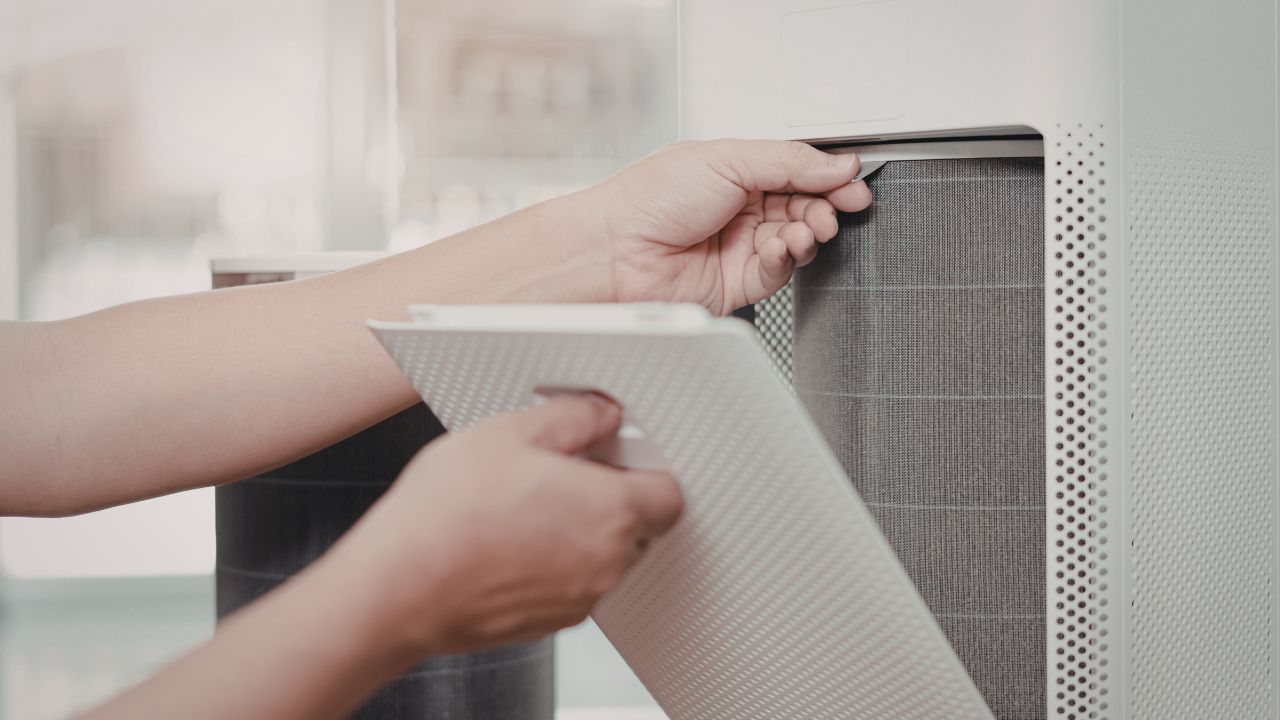
Whole-home purifiers mount directly into your central HVAC system and filter air as it circulates through the ductwork. The advantage is coverage — every room gets filtered air without placing individual units throughout the house. The limitation is timing. These systems only filter air when the HVAC blower is running, which may be less than 25% of the time during typical heating and cooling seasons. Running the fan continuously solves this, but increases electricity costs.
The price gap between portable and whole-home is significant. Whole-home systems range from $675 to $12000, depending on home size, system complexity, and filtration type. Replacement HEPA filters for these systems can run $200 or more. For a single problem room, a portable unit is far more cost-effective. For whole-house coverage — especially in homes with multiple allergy sufferers — the integrated system may justify the investment over buying and maintaining numerous portable units.
True HEPA Captures 99.97% Of Particles — "HEPA-Like" Has No Standard Definition.
HEPA stands for High-Efficiency Particulate Air, and the standard is precise: a true HEPA filter captures at least 99.97% of airborne particles measuring 0.3 microns in diameter. That size — 0.3 microns — is deliberately chosen because it's the most penetrating particle size, meaning it's the hardest for filters to catch. Everything larger or smaller is actually captured at even higher rates.
Advanced grades push further. H13 HEPA filters remove 99.95% of particles down to 0.2 microns. H14 filters reach 99.995% at the same size. The American College of Allergy, Asthma & Immunology recommends true HEPA filters in portable purifiers and MERV 11–13 rated disposable filters for central HVAC systems. The critical distinction: "HEPA-like," "HEPA-type," and "HEPA-style" are marketing terms with no regulated performance threshold. If the label doesn't say "True HEPA," there's no guarantee it meets the 99.97% standard.
Activated Carbon Removes Gases and Odors That Particle Filters Cannot Touch
HEPA filters excel at trapping solid particles but do nothing for gases. That's where activated carbon comes in. These filters use a bed of porous carbon material to adsorb gaseous pollutants — including VOCs, cooking odors, smoke chemicals, and off-gassing from furniture and building materials. The process is chemical, not mechanical: gas molecules bond to the carbon surface and are held there.
Effectiveness depends almost entirely on how much carbon is packed into the filter. Thicker filters with more material perform measurably better than thin ones. One notable gap in the industry: there is currently no widely adopted performance rating system for gas removal in portable air cleaners, unlike CADR for particles. That means comparing activated carbon performance across brands is harder for consumers. Replacement filters cost up to $50 each, and many air purifiers combine HEPA and activated carbon in the same unit to address both particles and gases simultaneously.
What Types Of UV Lights Exist For HVAC Systems, And What Do They Target?
UV light purification in HVAC systems uses germicidal radiation to kill or deactivate biological contaminants. There are two main system types, each targeting a different problem. Knowing which does what — and what neither can do — prevents you from buying the wrong solution or expecting results the technology can't deliver.
UV-C Light Destroys DNA In Bacteria, Viruses, And Mold To Prevent Replication
UV-C radiation operates in the 220–280 nanometer wavelength range. At these wavelengths, the light penetrates microorganism cell walls and damages their DNA and RNA, making them unable to reproduce. A 2023 systematic review published in Energies confirmed that UV-C is effective across a broad spectrum of pathogens. Typical dosages required to kill 90% of most bacteria and viruses fall between 2,000 and 8,000 microwatt-seconds per square centimeter.
The pathogen coverage is extensive. UV-C inactivates common bacteria, including drug-resistant strains, influenza viruses, and coronaviruses — including MERS, SARS, and SARS-CoV-2. That range makes it a genuinely useful technology for reducing biological contamination inside HVAC systems. The key limitation is exposure: the microorganism must be directly hit by the UV-C light for a sufficient duration. Anything shielded by dust, embedded in porous material, or passing too quickly through the light's range may survive.
Coil Lights Run Continuously On Surfaces — In-Duct Lights Target Airborne Pathogens In Transit
The two UV system types serve fundamentally different purposes. Coil-sanitizing lights mount directly next to the evaporator coil and run 24/7. Their job is surface sterilization — preventing mold and bacteria from colonizing the coil, which stays perpetually damp during the cooling season. Because the light shines on the same surface continuously, exposure time is essentially unlimited. This makes coil lights highly effective at what they do. The practical benefits include reduced odors, cleaner coil surfaces, and improved system efficiency.
Air-sanitizing lights install inside the ductwork and target airborne pathogens as they pass through. The limitation is obvious: air moves through ducts quickly, so microorganisms get only brief UV exposure. Anything that passes outside the light's direct path or moves through too fast may not receive a lethal dose. Coil lights solve a surface contamination problem. In-duct lights address airborne pathogen spread. Neither replaces the other, and both have clear boundaries on what they can accomplish.
UV-C Effectively Prevents Mold Growth on Coils, but Cannot Replace Physical Cleaning
This is where UV light purification delivers its most consistent residential value. Evaporator coils are naturally prone to mold — they're cold, wet, and dark. UV-C disrupts the chemical bonds within mold cells and prevents reproduction, making it particularly effective at keeping these surfaces clean. For homeowners dealing with musty HVAC odors or recurring coil contamination, a coil-sanitizing UV light directly addresses the root cause.
Two important caveats apply. First, the EPA notes that dead mold spores can still trigger allergic reactions. Killing mold on the coil doesn't remove the spores from the system — it just stops new growth. Typical home UV systems may not deliver enough exposure to fully neutralize all spores passing through. Second, NADCA is explicit: UV lighting does not clean HVAC systems. It prevents biological growth on targeted surfaces but does nothing about accumulated dust, debris, or existing contamination. A UV light installed over a dirty coil is treating symptoms while ignoring the problem. Physical cleaning comes first. UV maintenance keeps it clean afterward.
Do UV Lights And Air Purifiers Provide A Measurable Improvement, And How Should They Be Installed?
Both UV lights and air purifiers can improve indoor air quality — but only when the right technology is installed in the right location for the right problem. Measurable improvement means verifiable results, not vague promises. Proper installation is equally important: a well-chosen system installed incorrectly can underperform, waste money, or create new problems.
Measurable Improvement Means Verified Numbers, Not Subjective Claims
Two established standards give homeowners concrete benchmarks. For HVAC surface cleanliness after professional work, the NADCA Vacuum Test provides a quantitative threshold: debris collected from a cleaned surface must not exceed 0.75 milligrams per 100 square centimeters to pass. Any reputable cleaning company should be able to provide this verification.
For air purifiers, the CADR rating is the objective performance metric. Developed by the Association of Home Appliance Manufacturers, CADR measures the volume of filtered air delivered per minute across three pollutant categories — smoke, dust, and pollen. Higher numbers mean faster, more effective particle removal for that category. If a manufacturer can't provide a CADR rating or only offers vague language about "purifying" the air, treat that as a red flag.
Humid Climates And Strategic Lamp Placement Make UV Lights Most Effective
UV lights deliver their strongest returns in homes where moisture is a persistent issue. In humid climates, evaporator coils stay wet longer during cooling cycles, creating ideal conditions for mold and bacterial growth. A coil-sanitizing UV light in this environment works continuously against an active, recurring problem, which is exactly when the technology justifies its cost.
Installation strategy matters as much as climate. The NADCA UV White Paper confirms that multiple lamps in strategic locations outperform a single randomly placed lamp. Reflective surfaces surrounding the installation area amplify UV effectiveness by bouncing light onto surfaces that a single lamp angle would miss. A professional installer should evaluate your specific system layout rather than defaulting to a one-size-fits-all placement.
Allergy Sufferers, Pet Owners, And Smokers See The Greatest Air Purifier Benefits
Air purifiers deliver the most value in homes with identifiable pollutant sources. The EPA and the ACAAI both point to the same high-benefit groups: households with allergy or asthma sufferers, pets that shed dander, smokers, or lingering renovation dust. If none of these conditions apply and your home ventilation is adequate, a purifier may offer minimal noticeable improvement.
Sizing determines whether the investment actually works. For open-plan living spaces, the entire connected area counts when matching a purifier to its CADR rating — not just the room where the unit sits. Rooms with ceilings above eight feet require a purifier rated for a larger square footage than the floor plan alone suggests, because more air volume needs cycling. Undersizing is one of the most common reasons purifiers seem ineffective.
UV Lights Belong Near The Evaporator Coil — With Proper Shielding
The optimal location for a UV light is adjacent to the evaporator coil, commonly called the A-coil. This placement directly targets the surface most vulnerable to mold and bacterial colonization. A secondary lamp in the return air ductwork can address airborne pathogens, but this is an optional addition — the coil position delivers the primary benefit.
Safety requires attention to surrounding components. ASHRAE recommends shielding all organic materials within approximately five feet of the UV lamp. Filters, sealants, gaskets, and wiring insulation can all degrade under prolonged UV-C exposure, leading to air leaks or — in worst cases — fire hazards. Professional installation should always account for material shielding, not just lamp positioning.
Whole-Home Filtration Works Best As The Third Layer, Not The First
The EPA's framework for improving indoor air quality follows a clear priority order: source control first, home ventilation second, air cleaning third. Filtration is most effective when the first two strategies are already in place. Removing pollutant sources — fixing leaks, eliminating mold, and stopping tobacco smoke — reduces the load your filtration system has to handle. Adequate ventilation dilutes whatever remains.
ASHRAE Standard 62.2 provides specific guidance for residential ventilation, emphasizing mechanical whole-house systems that balance energy efficiency with sufficient fresh air exchange. In tightly sealed modern homes, relying on filtration alone without adequate ventilation can trap contaminants indoors rather than removing them. The filtration system cleans recirculated air; ventilation replaces it.
Wrong Wavelength, Wrong Filter, Or Wrong Placement Creates Real Problems
Three installation mistakes cause the most trouble. First, UV lamp wavelength matters critically. Lamps emitting at 185 nanometers generate ozone — a harmful lung irritant. Only 254-nanometer lamps should be used in residential HVAC systems to avoid introducing a new pollutant while trying to eliminate existing ones.
Second, improper UV placement without material shielding degrades plastic and rubber HVAC components over time. This damage is gradual and often invisible until air leaks or system failures appear months later. Third, installing higher MERV filters without confirming your HVAC system can handle the increased pressure drop restricts airflow and forces the blower to work harder. The result is higher energy consumption, uneven temperatures, and potential equipment damage — the opposite of a healthy home environment.
Ready For Cleaner Air? Let Alpine Help You Breathe Easier
The right indoor air quality solution depends on your home, your health, and your specific problems — not on marketing claims. HEPA filtration, UV coil lights, proper ventilation, and regular HVAC maintenance each solve different issues. The wrong combination wastes money. The right one changes how your home feels every day.
At Alpine Plumbing Heating and Air, we help homeowners cut through the noise and invest in what actually works. Whether you need a system evaluation, UV light installation, filtration upgrade, or professional maintenance, we'll give you honest recommendations based on your home's real conditions. Contact us today to schedule a consultation.