Leak detection methods have evolved beyond traditional visual inspections, offering homeowners precise diagnostic tools for hidden plumbing failures. Electronic, thermal, and acoustic technologies utilize different scientific principles to locate water, gas leaks, and refrigerant leaks with varying accuracy. Understanding how these leak detection methods function helps property owners select appropriate technology for specific pipe materials and environmental conditions. Modern diagnostics reduce unnecessary excavation while improving repair targeting.
Key Takeaways
- Electronic leak detection achieves pinpoint accuracy within 3/8 inches but remains limited to non-metallic pipes only
- Thermal imaging quickly scans large surface areas but struggles with deep underground leaks and uniform temperatures
- Acoustic detection reaches 70-85% accuracy with analytics yet faces challenges in high-noise environments
- CCTV inspection holds 65% market share despite identifying only 19% of defective tap connections
- Combining multiple technologies—thermal first, acoustic second, electronic third—delivers the most accurate, least-invasive results
What Are the Primary Leak Detection Techniques?
The plumbing diagnostic industry relies on five core sensing technologies that identify leaks through different measurement approaches. CCTV visual inspection, Focused Electrode Leak Location (FELL), acoustic detection, thermal imaging, and electronic locating each serve distinct diagnostic purposes. Each method addresses specific pipe materials, pressure conditions, and depth requirements. Professional technicians often combine multiple approaches to overcome individual limitations and confirm findings.
How Do Electronic Leak Detection Methods Work?
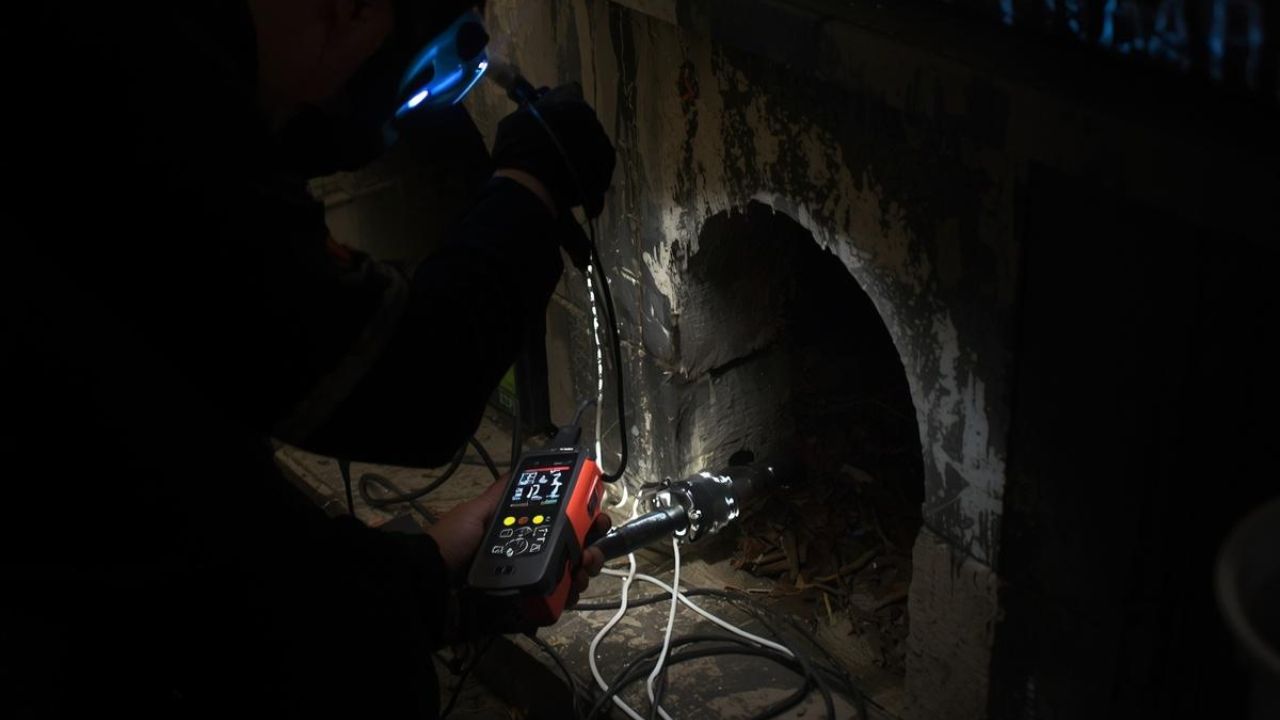
Electronic leak detection uses line tracing technology, leak detector sensors, and listening devices to map water distribution systems with precision. FELL uses high-voltage testing and electrical current to measure variation through pipe walls to identify defects in non-metallic materials. FELL locates leaks within 3/8 inches (1 cm) and quantifies each leak in gallons per minute. The technology is limited to non-metallic pipes because metal conducts electricity differently from PVC or clay.
FELL requires proper grounding and controlled water flow during testing. The technology successfully matches leak locations to specific pipe walls, joints, or tap connections. Electronic methods provide pinpoint accuracy that significantly reduces the required repair area. However, an electronic leak detector often requires a combination with thermal or acoustic methods for initial broad-area scanning.
What Is Thermal Imaging and How Is It Used for Leak Detection?
Thermal imaging cameras produce a detailed thermal image that visualizes surface temperature patterns caused by moisture intrusion or heat transfer in building materials. Thermal imagers don't directly see water but detect evaporative cooling or heat signatures from hot water lines. Thermal sensitivity determines how accurately the device captures temperature fluctuations between wet and dry zones, and performance drops when ambient temperatures are uniform. The technology is less effective for deep underground leaks because soil insulation dampens those surface temperature fluctuations.
External factors like sun exposure and HVAC ducts can create false temperature readings; technicians often supplement thermal imagers with a moisture meter to confirm moisture intrusion levels behind walls or under floors. In HVAC systems, heated diode leak detectors and a refrigerant leak detector confirm refrigerant leaks that thermal cameras first flag as cold anomalies. Despite these limitations, thermal imaging scans quickly across broad surface areas, including walls, ceilings, and concrete slabs. The technology excels at rapidly narrowing high-probability zones before technicians deploy more precise methods.
How Does Acoustic Leak Detection Identify Leaks?
Acoustic detection uses sensitive microphones to detect sound frequencies from escaping pressurized water through concrete and soil. Acoustic leak detection achieves 70-85% accuracy with analytics integration that filters ambient noise and recognizes leak patterns. Acoustic struggles in high ambient noise environments, including traffic corridors, mechanical rooms, and densely populated urban settings. It's less effective for extremely small leaks that generate insufficient sound pressure above background noise.
Acoustic sound can be dampened by certain pipe materials, including heavily insulated lines or pipes buried in dense clay. Modern systems integrate advanced analytics for noise filtering and frequency pattern recognition that improve detection reliability. The technology works best on pressurized water distribution lines where escaping fluid generates consistent acoustic signatures.
What Are the Core Differences Between Electronic, Thermal, and Acoustic Methods?
Each diagnostic technology offers distinct accuracy levels, detection ranges, and operational limitations. Electronic methods excel at pinpoint location but require non-metallic pipes, while thermal imaging covers broad areas quickly. Acoustic detection performs best on pressurized systems despite struggling with background noise. Understanding these differences helps professionals select appropriate technologies for specific conditions.
How Do Accuracy and Detection Range Compare?
CCTV operators identified only 78 joint defects in 54,500 linear feet during a comprehensive North American benchmark study. CCTV recorded only 19% of defective tap connections despite visual inspection of every pipe segment. Over 99% of joints were incorrectly ranked as 'leak-free' by CCTV because visual assessment cannot penetrate pipe walls. Electronic FELL technology achieves superior accuracy by measuring actual water flow through defects rather than surface appearances.
Acoustic systems reach 70-85% accuracy when integrated with analytics that distinguish leak frequencies from ambient noise. Thermal imaging provides rapid, broad-area scanning but lacks precision for exact repair targeting without confirmation. CCTV remains valuable for identifying blockages and structural damage, but fails at quantifying leakage rates.
What Are the Advantages and Limitations of Each Method?
CCTV cannot determine if cracks penetrate pipe walls or remain superficial surface defects. CCTV cannot accurately assess joint seals because rubber gaskets and cement joints appear similar in video footage. The visual nature of CCTV leads to incorrect leak-free rankings when moisture seepage occurs without visible pipe damage. Electronic leak detection often requires a combination with other methods for initial problem localization.
Thermal imaging excels at quickly defining suspect areas but requires confirmation through acoustic or electronic methods. Acoustic detection demands active pressurized flow to generate detectable sound, limiting effectiveness on gravity sewer systems. FELL technology quantifies leak severity by measuring flow rate in gallons per minute, providing data for repair prioritization decisions.
Which Pipe Materials and Environments Suit Each Technology?
Electronic FELL methods work exclusively on non-metallic pipes, including PVC, clay, concrete, and certain composite materials. Metal pipes require acoustic or thermal detection because electrical current behaves differently through conductive pipe walls. Thermal imaging performs best on accessible surfaces, including interior walls, ceilings, and exposed concrete slabs. Deep underground installations exceed thermal imaging's effective detection range due to soil insulation.
Acoustic detection suits pressurized water distribution systems regardless of pipe material when sufficient pressure generates detectable sound. Gravity sewer systems require FELL or CCTV because passive flow generates insufficient acoustic signatures. Understanding how water leak detection works helps homeowners recognize which technology applies to their plumbing configuration. Environmental conditions, including ambient noise, soil type, and depth, significantly influence method selection.
When Should Each Leak Detection Method Be Applied?
Application timing depends on property type, pipe accessibility, pressure conditions, and leak severity. Early leak detection is the goal for residential properties, which typically begin with thermal or acoustic screening before deploying precision electronic methods. Commercial facilities often require acoustic monitoring on pressurized distribution systems. Municipal infrastructure managers schedule regular FELL inspections on gravity sewer networks to quantify inflow and infiltration.
Which Methods Are Ideal for Residential Vs. Commercial Settings?
Average residential sewer camera inspection costs $999, with most homeowners spending between $270 and $1,730. Residential applications favor CCTV for baseline visual assessment combined with acoustic detection for pressurized water leaks. Commercial properties require more sophisticated approaches, including robotic crawlers for large-diameter pipes.
Electronic leak detection suits residential properties with non-metallic sewer laterals requiring precise repair location before excavation. Commercial facilities benefit from acoustic monitoring systems that continuously scan distribution networks. Signs you need plumbing leak detection include unexplained water bill increases, moisture stains, and foundation settling. Multi-unit residential and commercial buildings justify higher diagnostic investment because leak damage affects multiple occupants.
How Do Pressure and Environmental Conditions Affect Method Selection?
Pressurized water lines require acoustic or electronic methods that detect active flow through defects under normal operating pressure. Gravity sewer systems operate without pressure, necessitating FELL or CCTV technologies. High ambient noise environments limit acoustic detection effectiveness significantly. Underground depth exceeding three feet reduces thermal imaging reliability because soil insulation prevents surface temperature variations.
Pipe material composition directly determines whether electronic FELL methods can function on non-metallic installations. Accessible surface areas favor thermal imaging for rapid initial scanning. Finding reliable leak detection services nearby ensures technicians select appropriate methods for specific environmental constraints.
What Are the Ideal Use Cases for Each Technology?
CCTV inspection serves pre-purchase property assessments, post-repair verification, and baseline condition documentation. Thermal imaging excels at interior leak searches, including slab leaks, shower pans, underfloor heating pipe failures, and hot water circulation systems, as well as air leaks in building envelopes. Acoustic detection suits active leak searches on pressurized distribution networks before visible damage appears. Electronic FELL methods apply to municipal sewer systems requiring quantified leakage data for EPA compliance reporting.
Robotic crawlers handle large-diameter storm drains and municipal trunk lines. Understanding why leak detection services are important helps property owners prioritize preventive diagnostics over reactive emergency repairs. Each technology delivers optimal results when applied to pipe materials, depths, and pressure conditions matching its operational design.
How Do Consumers and Professionals Prioritize Leak Detection Factors?
Decision factors vary between residential homeowners seeking immediate problem resolution and municipal managers optimizing long-term infrastructure investments. Accuracy ranks as the primary concern for commercial and municipal clients aiming to minimize unnecessary excavation costs. Cost sensitivity drives residential consumers toward basic CCTV inspections despite superior accuracy from advanced diagnostic methods.
What Influences Consumer Preferences for Each Method?
Property owners prioritize accuracy, cost, and non-invasive nature when selecting diagnostic technologies. Residential consumers favor familiar CCTV inspection because video provides visual proof of pipe conditions. Commercial clients value quantified leakage data from FELL systems supporting repair prioritization and budget allocation. Technology awareness remains limited among homeowners who rely on plumber recommendations.
Insurance claim requirements sometimes mandate specific diagnostic methods, including thermal imaging for water damage investigations. Real estate transactions commonly specify CCTV sewer line inspections as contingency items. Home plumbing safety concerns motivate proactive homeowners to schedule periodic inspections on aging distribution systems.
How Do Regional and Demographic Factors Affect Adoption?
Urban areas show 72% CCTV preference driven by complex infrastructure, higher property values, and severe excavation disruptions. Suburban areas show 68% CCTV reliance for routine maintenance and real estate transactions. Rural regions demonstrate lower overall adoption rates with delayed maintenance until catastrophic failures. Homeowners aged 25-40 exhibit a higher inclination toward advanced methods, including thermal and electronic leak detection technologies.
Property owners aged 60+ tend to rely on traditional plumbing advice and standard CCTV inspections. Income levels exceeding $100,000 correlate with increased willingness to pay for premium multi-tool diagnostic services. North America holds 38% of the global market share, reflecting significant infrastructure investment and stringent regulatory requirements. Asia Pacific regions project 9.5% CAGR driven by rapid urbanization and expanding municipal water systems.
What Role Do Cost and Convenience Play in Method Choice?
Budget constraints limit residential consumers to basic CCTV inspections, averaging $999, despite superior accuracy from combined diagnostic approaches. Commercial property managers justify higher diagnostic costs when preventing business interruption from emergency plumbing failures. How much leak detection services cost depends on technology selection, property accessibility, and the required inspection extent.
Non-invasive methods command premium pricing but deliver value through avoided demolition, landscaping restoration, and interior finish replacement. Property owners increasingly recognize that early water leak detection can save money compared to emergency repairs after catastrophic failures. Time-constrained homeowners prefer comprehensive single-visit diagnostics over multi-day investigation processes.
What Are the Typical Costs and Equipment Investments for Each Method?
Service costs and equipment investments vary dramatically based on technology sophistication, property complexity, and regional market conditions. Residential diagnostic pricing ranges from budget CCTV inspections at $150 to premium multi-tool investigations exceeding $5,000. Equipment purchase decisions reflect business models with professional contractors investing in comprehensive diagnostic toolkits.
How Do Service Costs Compare Across Methods?
CCTV inspection costs range from $150-$300 budget options to $300-$600 mid-range and $600-$1,500+ premium services. Electronic leak detection costs span a $500-$1,500 budget, $1,500-$3,000 mid-range, and $3,000-$5,000+ premium applications. Acoustic/ultrasonic costs include a $250-$500 budget, a $500-$1,000 mid-range, and a $1,000- $2,500+ premium service. Thermal imaging costs cover a $200-$400 budget, a $400-$800 mid-range, and a $800- $1,500+ premium service.
Price variations reflect property accessibility, inspection extent, required travel distance, and technician expertise. Municipal contracts typically negotiate volume pricing for routine inspection programs. Emergency after-hours service commands 50-100% premium pricing. Combined multi-tool diagnostics reduce overall investigation costs compared to sequential single-method attempts.
What Are the Equipment Purchase and Rental Price Ranges?
CCTV push cameras cost $300-$1,000 entry-level and $2,500-$10,000+ professional systems. Robotic crawlers require a $15,000- $50,000+ professional purchase. Acoustic imagers range from $2,000-$4,000 entry-level to $8,995-$10,000+ professional units with analytics integration. Thermal cameras span $300-$1,000 entry-level and $3,000-$10,000+ professional models.
Daily rental rates include CCTV $100-$200, robotic crawlers $500-$1,000+, acoustic equipment $100-$200, and thermal cameras $50-$150. Equipment rental enables contractors to access specialized technologies without permanent capital investment. Professional service providers justify equipment purchases through high utilization rates.
How Can Multiple Leak Detection Technologies Be Combined Effectively?
Industry best practices emphasize layered diagnostic approaches that leverage each technology's strengths while compensating for individual limitations. Sequential application reduces false positives and confirms findings before invasive excavation or demolition. Multi-tool workflows minimize property damage while maximizing detection accuracy.
Thermal imaging is first to quickly scan and define suspect areas across broad surface regions. Acoustic detection is second to narrow the location to a smaller point when the leak is active under normal pressure. Electronic locating/CCTV third to confirm the exact repair spot and rule out false positives before excavation begins. This systematic progression balances speed, accuracy, and cost-effectiveness.
Initial thermal screening identifies high-probability zones requiring detailed investigation. Acoustic confirmation verifies active leakage and provides approximate location data. Final verification eliminates uncertainty before property owners authorize invasive repairs.
How Does Layering Methods Improve Accuracy and Reduce Damage?
Combined approaches reduce false positives that waste repair budgets on excavation at incorrect locations. Thermal imaging eliminates 70-80% of potential search areas before deploying labor-intensive acoustic or electronic methods. Acoustic detection narrows suspect zones to specific pipe segments. Electronic confirmation provides precise repair coordinates that minimize demolition and excavation.
Multi-tool protocols reduce total investigation time compared to trial-and-error single-method attempts. Property damage limitation justifies modest premium diagnostic costs through avoided demolition expenses. Professional service providers develop standardized workflows that optimize technology sequencing. Documentation from multiple methods provides comprehensive evidence supporting insurance claims.
What Are Industry Best Practices for Inspection Frequency?
Residential inspections are recommended every 1-2 years, especially for older homes or properties with previous plumbing issues. Municipal biennial inspection programs are recommended to prevent catastrophic failures. Pre-purchase property inspections should include a comprehensive CCTV sewer line assessment. Post-repair verification inspections confirm successful correction before contractors demobilize.
High-value properties justify annual thermal and acoustic screening. Commercial facilities with multiple tenants require quarterly acoustic monitoring. Municipal consent decree compliance often mandates documented inspection frequencies using quantified FELL data. Preventive diagnostic schedules reduce emergency repair costs while extending infrastructure service life.
What Insights Do Experts Offer on Leak Detection Trends and Innovations?
Technological advancement continues to reshape diagnostic capabilities through improved sensor sensitivity, analytics integration, and remote monitoring systems. Market growth reflects infrastructure aging across developed nations, combined with urbanization pressure in developing regions. Expert consensus emphasizes proactive maintenance programs over reactive emergency responses. Industry innovation focuses on autonomous inspection systems, artificial intelligence pattern recognition, and real-time continuous monitoring networks.
How Are Technological Advancements Shaping the Market?
The global sewer inspection systems market valued at USD 1.2 billion in 2024, reflects growing infrastructure investment worldwide. The market is projected to reach USD 2.5 billion by 2034, driven by urbanization and regulatory compliance. Market CAGR of 7.8% from 2024 to 2034 demonstrates steady adoption. CCTV systems hold 65% of the global market share in 2024 despite superior accuracy from emerging technologies.
Robotic Inspection Systems are growing at 10.5% CAGR as municipalities adopt automated inspection protocols. Analytics integration improves acoustic detection accuracy from 60% to 70-85% through machine learning pattern recognition. Artificial intelligence algorithms increasingly identify defect patterns in CCTV footage. Remote leak detection monitoring systems enable continuous surveillance on critical distribution networks.
What Case Studies Illustrate Effective Leak Detection Strategies?
Boulder, Colorado, integrated ITpipes with Esri ArcGIS in 2019 to modernize inspection data management workflows. A 14-mile North American benchmark study comparing CCTV vs FELL revealed significant accuracy gaps. 322 gravity sewer mains studied in benchmark comparison demonstrated FELL's superior leak quantification capabilities over CCTV. Boulder streamlined data management and improved workflow efficiency through automated inspection report generation.
Boulder, Colorado, manages a 388-mile sanitary sewer network using integrated diagnostic data supporting proactive asset management. The benchmark study revealed CCTV identified only 78 joint defects across 54,500 linear feet. Municipal adoption of quantified diagnostic methods supports regulatory compliance reporting required under EPA consent decrees.
How Is Urbanization Driving Demand and Method Adoption?
56% of the global population resides in urban areas as of 2024, creating unprecedented infrastructure maintenance demands. North America holds 38% of the global market share in 2024, driven by aging infrastructure replacement programs. Asia Pacific projected CAGR of 9.5% reflects rapid urban expansion requiring new sewer system construction. Urban density amplifies leak consequences through property damage affecting multiple structures.
Regulatory pressure increases as environmental agencies mandate reduced inflow, infiltration, and environmental impact from leaking infrastructure on local waterways and treatment systems. Climate change adaptation strategies require infrastructure resilience planning incorporating advanced diagnostic monitoring. Smart city initiatives integrate leak detection networks with broader utility management systems.
Comprehensive Comparison and Application of Electronic, Thermal, and Acoustic Leak Detection Methods
Selecting appropriate diagnostic technology requires understanding accuracy capabilities, cost implications, and environmental suitability. Electronic methods deliver superior precision on non-metallic pipes while thermal imaging provides rapid, broad-area screening. Acoustic detection excels on pressurized systems despite ambient noise limitations. Combined multi-tool approaches optimize accuracy while minimizing property damage through systematic diagnostic progression.
Professional guidance ensures homeowners select cost-effective diagnostic strategies matching specific pipe materials and accessibility constraints. Municipal infrastructure managers balance diagnostic investment against regulatory compliance requirements and long-term asset management objectives. The diagnostic industry continues evolving through technological innovation that improves accuracy, reduces investigation time, and enables proactive maintenance programs. Understanding fundamental differences between leak detection methods empowers property owners to make informed decisions, protecting infrastructure investments.
Get Expert Leak Detection From Alpine Plumbing, Heating, and Air
Early leak detection stops moisture intrusion before it causes structural damage, mold growth, or costly emergency repairs. At Alpine Plumbing, Heating, and Air, our licensed technicians use advanced sensing technologies — including thermal imaging cameras, leak detector sensors, heated diode leak detectors, and a refrigerant leak detector for HVAC systems — to accurately identify water, gas leaks, and refrigerant leaks throughout your home or business.
We check flow rate and monitor temperature fluctuations to confirm findings, and we use a moisture meter to assess moisture intrusion behind walls, under floors, and in underfloor heating systems. Our leak detection monitoring approach catches problems early, reduces environmental impact, and protects your property from hidden damage.
Serving homeowners and businesses across the San Gabriel Valley, we combine thermal imagers, acoustic tools, and electronic methods to deliver the most accurate, least invasive diagnosis possible. Contact us today for a free estimate and let our team protect your home from hidden water damage before it becomes a major repair.